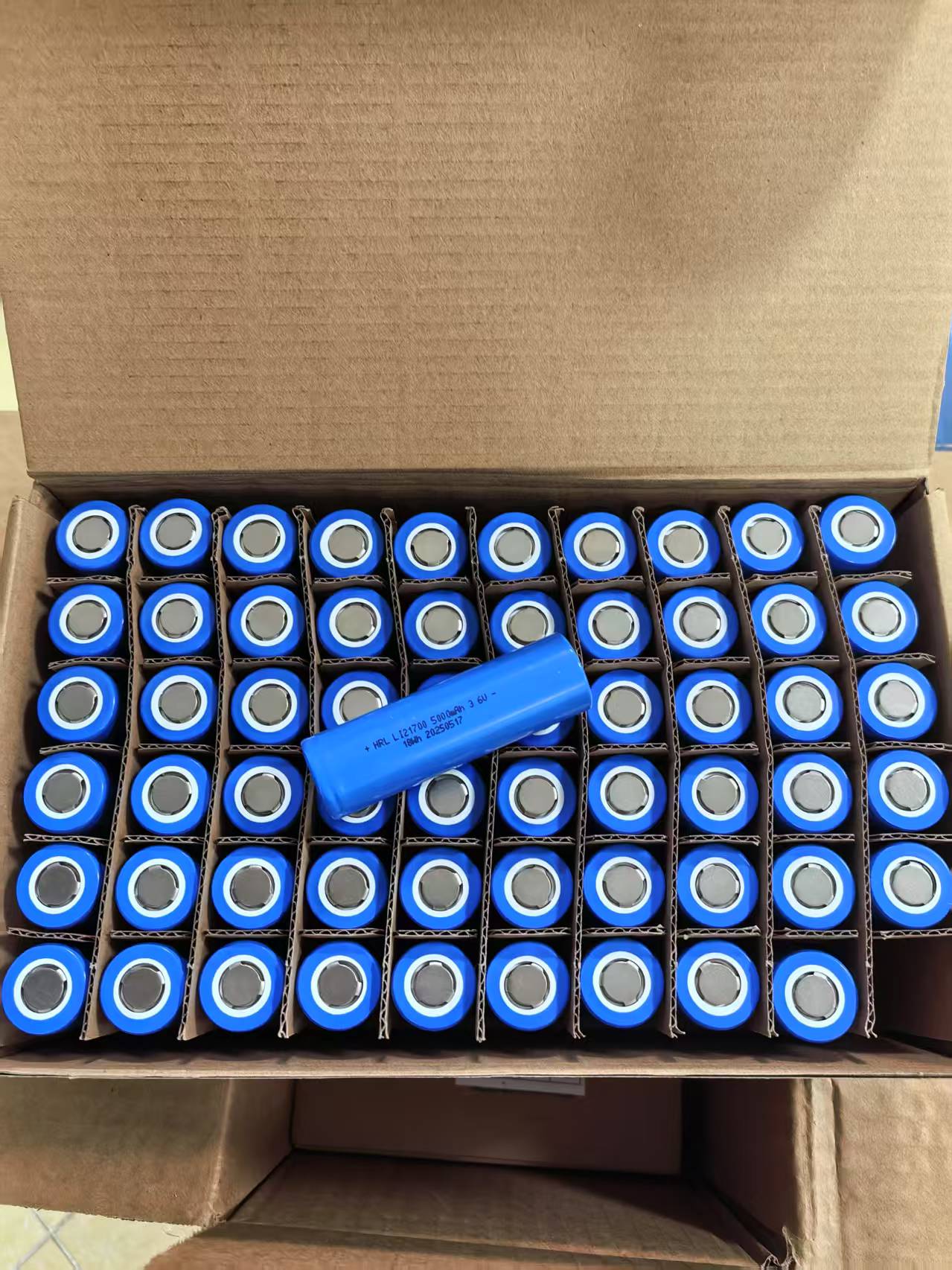
So why do so many internationally advanced drone customers favor HRLENERGY’s INR21700-P50C cells?
1) Endurance / Energy Density — Longer flight times or fewer cells
Advantages: 5.0 Ah capacity + typical energy density of approximately 260 Wh/kg achieve a “balanced energy and power” configuration within the 21700 form factor. For equivalent weight/volume, the P50B directly delivers extended endurance or reduces cell count (lowering BMS/wiring complexity).
2) Instantaneous Power for Takeoff/Climb (Low Internal Resistance) — High Thrust-to-Weight Ratio
Advantages: AC internal resistance ~6.5 mΩ (typical)/DC ~12.8 mΩ (typical). Low internal resistance minimizes voltage drop and thermal loss during high-current discharge, enabling higher short-duration power output (beneficial for takeoff, climb, and rapid acceleration scenarios). Officially positioned as a “high power/high energy density” cell.
3) High-rate discharge and fast charging (operational efficiency)
Advantages: A single P50 cell supports ~100W discharge and 5C fast charging capability. For drones requiring rapid turnaround (e.g., short-range logistics, frequent mission scheduling), this reduces ground charging time or enables higher-power tasks.
4) Low-Temperature / Extreme Environment Performance
The P50B maintains usable discharge capacity at -20°C (-4°F), exhibiting less extreme voltage collapse than some standard high-energy pouch cells under identical conditions. This makes it suitable for high-altitude and cold-region operations (though the entire drone system still requires preheating and thermal management).
5) Cycle Life (Operating Costs)
Advantages: Published Variable Charge/Discharge Rate (VCR) cycle tests demonstrate the P50C’s robust cycle life under reasonable usage conditions (maintaining ≥70% SOH after hundreds to thousands of cycles in certain tests). This significantly reduces replacement costs for commercial operations (actual lifespan varies by operating conditions).
Side-by-Side Comparison with Polymer Pouch Batteries (LiPo)
Polymer pouch batteries (e.g., common LiPo) are popular in consumer drones due to their flexible form factor and lower cost. However, the P50C outperforms in multiple parameters:
· Power Density: The P50C’s 15A high-discharge capability better suits high-performance drones, avoiding LiPo’s tendency to overheat under heavy loads.
· Safety: LiPo pouches are susceptible to physical damage causing swelling or fire, whereas the P50C’s hard-case design offers superior protection and lower thermal runaway risk—especially in collision-prone drone environments.
· Cycle Life & Durability: LiPo batteries typically experience significant capacity degradation after only 200-300 cycles, whereas the P50C achieves 500+ cycles (with a total cycle life exceeding 1400 cycles), reducing long-term replacement costs.
· Energy Efficiency: The P50C’s low impedance ensures higher efficiency (reducing heat loss), whereas LiPo’s higher internal resistance wastes more energy during flight, resulting in shorter actual flight times.
· Weight and Volume: While LiPo allows custom shapes, the P50C’s high energy density (5000mAh in a compact form factor) often results in lighter pack assemblies, making it ideal for performance-driven commercial drones.
Overall, the P50C is better suited for professional-grade drone applications, while LiPo remains more prevalent in entry-level or low-cost field applications.
Post time: Dec-09-2025


